
It's Baaaaack: Hillsboro (Again) Attempting to Annex Farmland

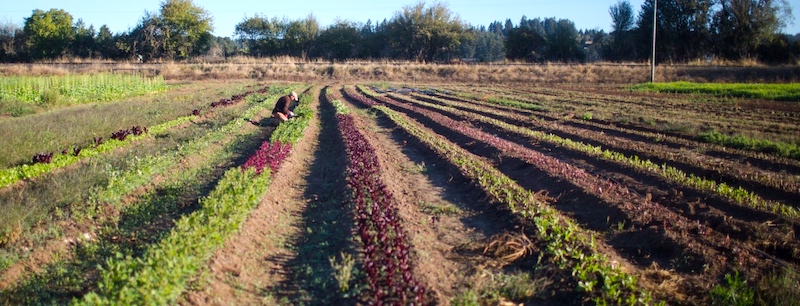
My latest CSA update from Aaron Nichols of Stoneboat Farm in Hillsboro on what to expect in our share included this note:

"As a lot of you know, I spend some of my extra time working to protect farmland around my farm that is consistently under threat of development from data centers and other industrial uses. Unfortunately, it appears that another very big threat to 1,800 acres of Oregon's very best farmland (that is almost visible from my farm) is looming. There is a legislative concept [a draft idea for legislation before it is introduced as a bill] that has had a hearing in Salem that would make the land available for development…despite the city and the state having promised it would stay in farming for at least another 40 years."

If this sounds familiar, you're not wrong. Just last July I wrote that the city of North Plains outside of Hillsboro had "attempted to double the size of the city by proposing the biggest-ever Urban Growth Boundary (UGB) expansion by percentage basis and the largest by acres in the metro counties." The voters of North Plains responded by rejecting the city's ballot measure by a margin of 70 percent.
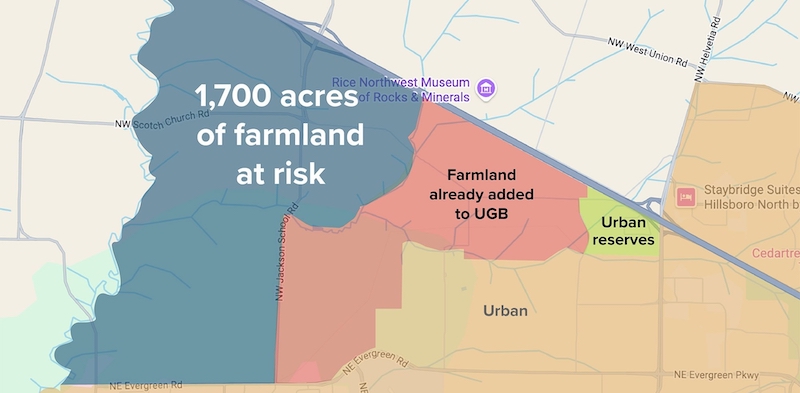
The "legislative concept" proposes to annex 1,800 acres of prime farmland.

Well, now it's Hillsboro's turn to take a turn at snatching what has been described as some of the richest farmland in the area, and this time they've upped the ante to four times the size of the North Plains grab.

Oregon has a rigorous process for expanding the UGB that this proposal attempts to shortcircuit. Rather than basing economic policy on verifiable needs, the so-called "Oregon JOBS Act" (LC 237) proposed by Hillsboro state senator Janeen Sollman sets a precedent of awarding land on a “who you know” basis. According to land-use advocates at Friends of Smart Growth, landowners in the area have been trying for years to get their land added to the UGB—not because it serves the public interest, but because their land value would increase by 50 times. The Smart Growth website says "the precedent set by this proposal would lead to a mishmash of laws and an unpredictable regulatory climate for businesses in and out of the UGB and would set aside the rule of law in favor of a system that is open to corruption and mismanagement."

For perspective, figures from the 2022 USDA Census of Agriculture show that the number of farms in Oregon decreased by six percent since 2017, and the acreage those farms occupied was down four percent in the same period. 1000 Friends of Oregon detailed that only about 16 percent of Oregon (excluding federal lands) consists of high-value soils, with only about four percent of those rated as prime farmland, and that efforts like the one proposed in this legislative concept endanger those remaining valuable soils.
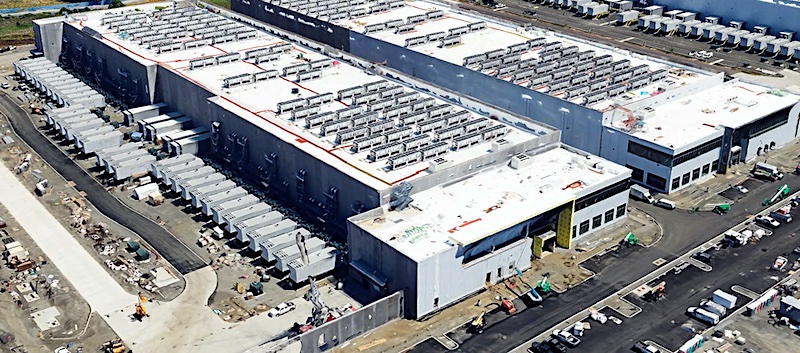
There are currently 131 data centers in Oregon according to recent reports.

The threat these data centers pose isn't limited to Oregon's diminishing agricultural land. According to an article in The Guardian, while data centers consume just one percent of the world's electricity now, "their share of U.S. electricity is projected to more than double to 8.6% by 2035."

1000 Friends points out that corporate data centers—the kind of industrial development most often discussed for this parcel—which are touted as super-charging job creation, actually create few, relatively low-paying jobs. Furthermore, it goes on to say that "the bill that Hillsboro state senator Janeen Sollman is proposing will extend tax breaks for these same corporations—companies that can easily afford to pay their fair share.

"Meanwhile, the state is slashing social services budgets that help keep Oregon’s working families afloat, [and] data centers are expected to increase PGE and Pacific Power rates by 50 percent in 5 years (despite the passage of the POWER Act), fresh water is being used and polluted by data centers, and data centers are costing Oregon hundreds of millions in tax revenue each year. Clearly, this industry is not benefiting most Oregonians."

ACTION ITEMS: There are several actions you can take on this issue.

North Plains Residents Resist Land Grab by City and Developers

In what was being termed one of the biggest threats to Oregon's land use system in 50 years, the City of North Plains, just outside of Hillsboro, attempted to double the size of the city by proposing the biggest-ever Urban Growth Boundary expansion by percentage basis and the largest by acres in the metro counties.

"A single increase of this magnitude to a city’s boundaries is unprecedented in Oregon, and most of the expansion would be for industrial and commercial use, with only about 167 acres set aside for housing," according to a 1000 Friends of Oregon article on the battle between residents, developers, city bureaucrats and state regulators.

The proposed North Plains expansion area (in red).

Local residents and farmers opposed to the land grab banded together under the banner Friends of North Plains Smart Growth, which quickly organized a coalition against the city's ballot measure on the expansion, explaining to voters what the city was attempting and notifying residents of upcoming public hearings.

Led in large part by farmer Aaron Nichols, whose 15-acre Stoneboat Farm was just one farm removed from the city's proposed boundary expansion, the opposition effort became what he called his "second job" for a year, learning the labyrinthine intricacies of Oregon's land use system, first notifying the 500 families served by the farm's Community Supported Agriculture (CSA) subscriptions and then contacting local media and conservation organizations.

Citing an almost complete lack of public engagement, Nichols testified that "of the 26 meetings North Plains pointed to as public evidence, only three of these were public hearings that both followed proper noticing requirements and had an opportunity for the public to engage." His testimony charged that the plan itself was "poorly supported" and that much of the basic evidence was exaggerated or was simply missing, pointing out that even Dr. Brenda Bateman, the director of the Oregon Department of Land Conservation and Development (DLCD) stated that the city's plan relied on "incorrect facts."

Jesse Nichols (left), Aaron Nichols (right) and Aaron's son Asa (on tractor).

Just-released figures from the 2022 USDA Census of Agriculture show that the number of farms in Oregon decreased by six percent since 2017, and the acreage those farms occupied was down four percent in the same period. 1000 Friends of Oregon detailed that only about 16 percent of Oregon (excluding federal lands) consists of high-value soils, with only about four percent of those rated as prime farmland, and that efforts like those of the city of North Plains endanger those remaining valuable soils.

Putting those figures into perspective, 1000 Friends said that "while cities normally need to prioritize expanding onto non-resource lands or lands with lower-quality soils when proposing a UGB expansion, North Plains is surrounded almost exclusively by high-value farmland and prime soils. This means that any expansion would almost certainly pave over some of the best soils in the state and raises the ethical bar for proving that the expansion is what’s best for the greater community."

Stoneboat Farm supplies 750 local families with vegetables through its CSA subscriptions.

Expansion advocates tried to propose a separate bill (HB 4026) that was characterized as "intentionally designed to circumvent and suppress democratic participation by blocking future ballot referendums." Nichols said the efffort was a warning to those who might face challenges to their own local urban growth boundaries: "What [HB 4026] does, in fact the only thing [it] does, is have the legislature insert itself into a local issue to put a roadblock in the way of a community group. This bill forces our group to sue the state and, though as we and the city know full well the law will be quickly overturned, the city hopes that we will either be unable to raise the money for the lawsuit or it will exhaust our resources and harm our campaign. It is obvious that…placing a hurdle in the road for one side in one election, is not the place of the Oregon Legislature nor worth the time used on this bill."

On May 22nd of this year, the voters of North Plains rejected the city's ballot measure by a margin of 70 percent.

The city's response to the vote indicated the battle is not over: "The recent dialog on Measure 34-327 has highlighted a shared commitment among North Plains residents to prioritize our community’s livability and managed growth responsibilities,” said Mayor Teri Lenahan. “We are very early in assessing next steps for a future UGB expansion area." A hearing to discuss next steps is scheduled for Monday, July 15.