Meeting My Heroes: Hani Almadhoun of Gaza Soup Kitchen

It's not often you get to meet your heroes in person, but I read a social media post from Hani Almadhoun that he'd be coming through Portland after meeting with supporters in Corvallis. It was part of his day job as Senior Director of Philanthropy for the United Nations Relief and Works Agency for Palestinian refugees (UNRWA) in Washington, DC, and I immediately asked if he'd have time for a quick interview. He graciously agreed.

Gaza Soup Kitchen is currently running 26 kitchens across Gaza.

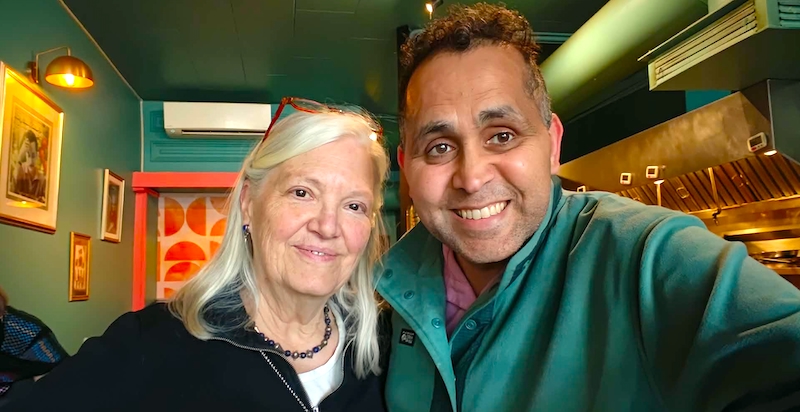
We met in early June at a Syrian café, Shami, across from Mt. Scott Community Center. Having only known him from his social media posts, I was surprised when a big guy in a green fleece jacket jumped up from a back table and introduced himself. The table was covered with UNRWA and Gaza Soup Kitchen t-shirts and tote bags—I'd neglected to wear my GSK shirt that day—and we were almost immediately joined by other supporters who shared plates of Syrian-style hummus, shawarma, kabobs and house-made lavash served by owner and chef Wael Elasady.

While his work with UNRWA is a full time gig, Hani spends much of his spare time raising funds for his passion project, the Gaza Soup Kitchen, as well as raising two young daughters with his wife at their home in Virginia. The Gaza Soup Kitchen was founded two years ago by Hani and his brother Mahmoud when Israel, with funding and weapons from the United States, began their bombing campaign bent on destroying Palestine and its people.

Gaza Soup Kitchen co-founder Mahmoud Almadhoun was assassinated by an Israeli drone.

With much of the population displaced and the country's infrastructure flattened, Mahmoud and a few helpers gathered three large pots and some scavenged firewood from the bombed-out ruins around them and began cooking soup for their starving neighbors. Several months into the genocide, Mahmoud was assassinated by an Israeli drone. His family, including his parents, children and extended family, while devastated in the aftermath of the terrible loss, kept their cooking fires lit and their community fed.

Hani now spends much of his time outside of work for UNRWA raising funds to purchase the food that the soup kitchen prepares—as well as reminding the world on Facebook and Instagram that the people of Palestine are still standing despite the horrific efforts of the Israeli government to erase them. With 26 kitchens currently in operation all over Gaza, their crew—all of whom are paid for their work—also pack bags of groceries, including cleaning and sanitary products, for distribution to displaced families living in tents. They also run medical points for first aid, distribute clean water, prepare and distribute meals for patients in the few remaining hospitals, and run schools for displaced children.

Waiting for food at the Gaza Soup Kitchen.

In a recent post on Facebook, he wrote:

I sometimes ask myself: when this is over, what will I do? What are my hobbies? What does my mind reach for when it is not carrying this? I honestly do not know anymore. The anniversaries alone — if we are lucky enough to survive to them — come with videos we have to revisit, family members we have to miss all over again. There is no clean way through that.

It has been going on so long I cannot imagine the other side of it. The person who sells homes or writes code or makes your overpriced cup of coffee can burn out and step away. This is not a job I can leave. It is tied to everything I define myself by. A simple hello to my parents on the phone brings it all right back. If someone is not feeling well, I catch myself praying they will not need a medical evacuation that is not coming.

Some of these posts heal me. Some of them cost me something. But I feel a fundamental obligation to keep writing.

Not because I am not exhausted. I am.

But staying quiet is a privilege I do not have. If I tune out, this becomes background noise. And these are not statistics. These are my people.

So I keep writing. Not because it is easy. Because it is the bare minimum I owe to the people living through it.

Several months ago Hani also began writing a book that he described as telling not only the story of the Gaza Soup Kitchen but the stories of the people of Gaza from inside the community—the loss, the grief, the activism. "I figured that we should tell our own story, as well," he said.

I'm looking forward to reading it.

Photos by Hani Almadhoun and Gaza Soup Kitchen staff.

Camp Stories: Revisiting Old Haunts, Rereading Old Books

We go camping over the Fourth of July, ostensibly for our dogs who have been prone to become drooling, shivering messes if we stay in town and attempt to survive the "celebrations" of our fellow citizens that turn our normally quiet, tree-lined neighborhood into a booming, smoke-filled, fiery war zone.

No fireworks here.

Our favorite getaway spot is a small, primitive campground midway up Mt. Adams in the Gifford Pinchot National Forest. Called Paradise Creek, it's nestled in the deep old growth forest north of Carson, Washington, at the intersection of its namesake Paradise Creek and the Wind River. With no electrical hookups and rusty-but-potable water pumped from a creaky old-fashioned cast iron hand well pitcher pump, it (mostly) discourages the big rigs and generator-dependant types from rumbling through the tents and small trailers dotting the two loops. 

We realized on this trip that we've been camping there almost every year for the past 20 years with our tent and queen-sized air mattress—a step up from the backpacking tent with two zip-together down bags on insulated pads employed by our younger selves. We've gone through only two Coleman camp stoves if you don't count the white gas Coleman borrowed from my parents that had already survived 30 years of Bauer family campouts, and tents ranging from that first two-person LL Bean backpacking tent Dave had bought used from a college friend, to a Columbia Sportswear Bugaboo that Dave (at 6'4") could stand up in to our current "two-room" giant from REI that we've dubbed the Circus Tent.

Our version of "roughing it."

We try to snag a non-reservable, first-come, first-serve site a couple of days before the holiday, preferably along the creek, and this year we lucked into a double site* set back from the road, enabling us to listen to the creek burbling along about 50 feet down a thin thread of trail opening onto a shady private "beach," perfectly suited to a couple of camp chairs and an afternoon spent reading.

Dave wanted to finish a couple of books he'd been trying to get through for awhile, and I'd brought along the relatively recent and well-reviewed "James," a retelling of Twain's Huck Finn from the perspective of the slave Jim, by Percival Everett, which Dave had read and gave the thumbs-up to. My first choice, however, was "Angle of Repose" by Wallace Stegner, a book I'd read ages ago and remembered liking despite its intimidating 600 pages. It got me on a Stegner kick back then, so I thought I'd give it a reread.

Something to warm our cockles in the evening.

It turned out to be a perfect vacation book, at least for me, a story (and a writer's voice) you get immersed in without much effort, though it's not what I'd call a light summer read. Told from the perspective of a 1970s-era retired history professor, Lyman Ward, Stegner's incredible prose and well-crafted story follows Ward's attempt to understand and document his grandmother's story of moving from a privileged East Coast society to move out West to follow her husband's itinerant career as a mining engineer.

Like many writers whose work I admire, I found myself stunned by Stegner's ability to bring people alive on the page and gobsmacked at his descriptions of places and atmosphere. For example, his description of the relationship between a writer and his characters, real or imagined, as expressed through Lyman's struggle to see and experience Susan Ward's life from her perspective:

“There is another physical law that teases me, too: the Doppler Effect. The sound of anything coming at you- a train, say, or the future- has a higher pitch than the sound of the same thing going away. If you have perfect pitch and a head for mathematics you can compute the speed of the object by the interval between its arriving and departing sounds. I have neither perfect pitch nor a head for mathematics, and anyway who wants to compute the speed of history? Like all falling bodies, it constantly accelerates. But I would like to hear your life as you heard it, coming at you, instead of hearing it as I do, a somber sound of expectations reduced, desires blunted, hopes deferred or abandoned, chances lost, defeats accepted, griefs borne.”

It's no wonder it won the Pulitzer, and got me started on a Stegner jag.


Read other Camp Stories (with more here) from our years of tent camping in the Pacific Northwest, as well as our best hacks to make it easy and fun.

* Double sites, if you're not aware, are generally intended for two or more tents and, at $45 per night, cost more than single sites. (We also can't use our National Parks Senior Pass for double sites, which halves the cost per night of a regular site.) But honestly, considering what a room rate or rental house would run, it's more than worth it. 

Easy Early Summer Stew: Kimchi Jjigae

In the Pacific Northwest, early summer and late spring can feel like fraternal twins. So much alike and yet, at the same time, so different. Just as you're ready to toss your hoodies and jeans into the bottom drawer of the dresser until you reluctantly dig them out again in the fall, a cool maritime front blows in from the coast causing the mercury to plummet 20 degrees.

In cases like that—and I'm not speaking hyperbolically, since today's 94 degrees is predicted to be a cool 75 tomorrow—it's wise to have a good soup recipe sequestered in your back pocket when the chillier of our early summer twins is in residence. Luckily for me, I found an extra jar of my favorite local kimchi hanging out in the back of the fridge (we're out of my homemade kimchi, a situation soon to be remedied in about a month when Napa cabbage is available at the farmers' market) along with a tub of local Ota tofu and just enough leftover roasted chicken to shred into it.

Oddly, in searching through recipes online, I came across one from Joanne Molinaro, aka The Korean Vegan, that called for black beans to be added to this most Korean of stews. Coincidentally I had just cooked up a big pot of those legumes and, since Joanne said it was okey-doke to add them, I did, though not only for the added fiber alone. Just two cups of beans added a pop of color and a bit of that bean-y texture that complemented the crunch of the fermented cabbage quite nicely. It might just be a combo I'll try in other dishes.

Kimchi Jjigae

1 Tbsp. sesame oil
2 Tbsp. gochugaru
1/2 c. diced onion
4 green onions, sliced crosswise into 1" pieces
3 cloves garlic, minced
1 medium-sized potato, chopped into 1/2" dice
2-3 c. Napa kimchi (cut into bite-sized pieces)
3 Tbsp. gochujang
2 Tbsp. soy sauce
1/2 c. water
4 c. stock (chicken or vegetable)
1 16-oz. block medium firm tofu, diced
2 c. cooked, drained black beans or 1 15-oz. can of black beans, drained
1-1 1/2 c. shredded chicken (optional)

Heat a Dutch oven or your favorite soup pot over medium heat, then add sesame oil until it shimmers. Add gochugaru and cook for about one minute, then add onion and sauté until onions begin to become translucent. Add green onions and garlic, stirring often to keep the gochugaru from sticking to the bottom of the pot.

Add potatoes, kimchi, and gochujang, stirring to combine. Add water and soy sauce, stir, then add stock. Bring to a boil, reduce heat to low and simmer for 20 minutes. Add sliced tofu, black beans and shredded chicken, if using, return stew to a boil, reduce heat and simmer for 15 minutes. Serve with jasmine rice. Garnish with toasted sesame seeds, roasted unsalted peanuts or more finely sliced green onions if desired.

In Season: Serving Up Summer

Early summer whets my appetite for what's to come in the Pacific Northwest: First to trickle in from our fields both cultivated and wild are the earliest greens—nettles, fiddleheads and fava tops among them—then comes asparagus, green garlic, early strawberries and the softest young lettuces, soon followed by the briefest appearance of our native, and much anticipated, Hood strawberries, along with fava beans, spinach, mustard greens and more exotic friends like agretti and komatsuna.

While local farmers are starting to worry about what's looking like a hot, dry summer requiring the trouble (and expense) of near-constant irrigating, the relatively mild spring was beneficial for getting a jump on planting, weeding and the growth of the tender seedlings that will be harvested later in the summer and fall. In his weekly newsletter to subscribers, my CSA farmer Aaron Nichols of Stoneboat Farm wrote:

"It's a mixed bag for the spring crops, some are coming on quick and very well (hello fava beans!) and others seem a bit behind (broccoli and cabbage) or are being very temperamental (we're looking at you radishes!).  A lot of things we plan to have for a few weeks are wrapping up in one or two this spring but, so far, it's been fine as other things are ahead of schedule.  I'm pretty worried for a hot summer but no point in borrowing that trouble now!"

Revel in the freshness of summer produce, but don't forget to preserve it for later!

This season always gets my juices flowing for preserving the freshness of summer. After gorging myself on fresh strawberries and shortcakes, I turned around and made three batches of strawberry jam to replenish our dwindled supply from last summer, and I'm already anxiously anticipating the raspberries, blackberries and plums that are on the way. (Check out my hack for perfect fruit jam.) The radishes that Aaron mentioned above went into four jars of simple pickled radishes for our taco Tuesdays, and soon cucumbers will be sliced into rounds and given the hot brine treatment as well!

I'll also be eagerly anticipating the Napa cabbage due to appear in our CSA share and at farmers' markets toward the end of the month, since we are desperately in need of kimchi made from my friend Denise's family recipe. And with cabbage season comes homemade sauerkraut to have with all the grilled things.

Let me know if you have any favorite recipes for preserving the best of what's in season this summer and I'll do a follow-up post on what I learn. Let's share!

Fava Beans: To Peel, or Not to Peel?

Once again, it's confession time.

I love fava bean season so much that, at the first sign of the bundles of young green shoots on farmers' market tables in the spring, I get a little giddy thinking of them stir-fried with garlic and tossed with pasta and preserved lemon, or slathered with oil and roasted, served alongside a beautiful grilled, pasture-raised chicken thigh. Then there's the knowledge that in just a couple of weeks, it'll be time for the pods to start appearing, their strange, off-green, blobby exteriors revealing pale green kidney-shaped beans pillowed in a porous white cushion.

My neighbor Bill loves his favas and grows more than enough to share. Lucky me!

That's about when I remember that to prepare these little beany delights, I have to strip them out of their pods, boil them in a salty pot of water, then spend what seems like hours in the tedious task of popping them out of their skins to get a paltry—albeit decidedly delicious—pile of the bright green, shiny jewels.

I know, I'm whining.

But, wonder of wonders, my friend Nancy Harmon Jenkins, part-time resident of Italy and author of well-regarded books on Italian cuisine like the groundbreaking New Mediterranean Diet and Virgin Territory: Exploring the World of Olive Oil, saved me (and you) from hours of whinging.

Shucked and ready to boil and use!

In a post on her blog, she excoriates Americans who insist on peeling the skins from their beans:

"What a waste of time! What a waste of flavor!

"Where does this weird practice come from? I suspect from the French professional kitchen where chefs are constantly challenged to come up with new tricks and trucs to keep their enormous brigades de cuisine in operation. In Italy, where restaurant kitchens are run much more economically, no one has to dream up tasks—there are enough to go around and more.

"But why do Americans insist on this? Every food writer except one (me) says you have to peel beans. Then they go through elaborate rigmaroles to show you how to do it. No wonder fava beans are not exactly popular despite their magnificent, slightly earthy flavor, so very different from string beans or limas. Every spring or summer I feel like climbing up in the pulpit and shouting: YOU DON’T HAVE TO DO THAT—IN FACT, IT IS COUNTER-PRODUCTIVE!!!"

Toss the cooked beans with Oregon albacore and pasta…so simple, so delicious!

Which, as you might imagine, got my attention. And came in mighty handy when my neighbor called offering a grocery bag full of freshly harvested favas from his garden. Let me tell you, I never relished preparing beans more—just shuck, boil in a pot of salted water for ten minutes and they're ready!

While there's a vast universe of serving suggestions, and more cultural trivia about these delicate denizens of early summer, for me, I used some of my neighbor Bill's beans tossed with preserved lemon and albacore, tossed with pasta, sprinkled with chive blossoms and chopped chives, then used the rest to make the following dip for guests. Though when everyone oohed and aahed over the amount of work it took to peel all those beans, I was torn about revealing my secret. (Psst…I did.)

Fava Bean Spread

3 c. shucked beans
2 cloves garlic
1/2 fennel bulb, cut in half, cored and roughly chopped
1/4 c. parsley, coarsely chopped
1/4 c. mint, coarsely chopped
1/3 c. fresh lemon juice
3-4 Tbsp. olive oil
Salt, to taste

Bring a large pot of well-salted water to a boil. Drop in fava beans and cook for ten minutes. Drain and run under very cold water (or ice bath) until cool.

Put beans, garlic, fennel, parsley, mint and lemon juice into the bowl of a food processor. Turn on and while its running drizzle in olive oil until puréed. Adjust lemon juice and olive oil and add salt to taste. Serve with slices of rustic bread or crackers, or on toasted slices of baguette (à la bruschetta).

Growing Gardens: Planting Seeds of Resilience Rooted in Community

This article was written by Portland author Peggy Acott to celebrate the 30th anniversary of Growing Gardens.

Beginning in 1996 with a staff so small you could count them on one hand and still have fingers left over, Growing Gardens is today a robust group of nearly fifty, with program volunteers numbering more than a hundred. They are passionate and persistent in their goal to create a sustainable and equitable food system.

Here in Oregon, as in many regions of the country, hunger and food insecurity are on the rise in this time of perilous economic and political uncertainty, a condition that disproportionately impacts BIPOC and LGBTQIA-plus communities.

The Home Garden Program has created over 3,000 backyard gardens.

Growing Gardens confronts this imbalance in the food system head on, in very direct ways: The Home Garden Program, which has to date created over 3,000 backyard gardens; a school garden program for students from elementary through high school; and the Lettuce Grow Program, where over 1,500 incarcerated adults and juveniles have access to gardening and garden-based education, with the added benefit of learning job skills that can assist in the successful re-entry back into society.

One of the team members sums it up this way: “What we’re really building is so much more than gardens. We’re growing futures rooted in health, self-sufficiency, and deep community connection.” 

Portland Youth Builders offers a program of high school completion, vocational training, counseling, and long term support.

When COVID erupted in 2020, the disruption and challenges of lockdowns and interrupted supply chains were immediate and far-reaching. In order to survive, the staff and volunteers employed a combination of online programming and strict distancing practices, and made at-home garden and plant-related projects for students while schools remained closed. It was a demanding and difficult period, but they were committed to keep their mission alive. 

“Any nonprofit that survived and made it through was a huge success,” says Executive Director Jason Skipton. “We had to completely transform our programs, but we weren’t going to give up, because ‘No’ was not an answer we could give the community.” 

Skipton explained that there had been energy and determination in both the local and national government to allocate funds and resources to help service organizations during the pandemic. But then, just when Skipton and his staff thought the struggle was behind them and were eagerly planning toward the future, the freezing of federal funds in early 2025 dealt them a devastating and demoralizing blow.

“The rug has been ripped out from under us. Now what we’re facing is a political pandemic,” says Skipton, “and we are fighting every day to maintain, be relevant, and keep the doors open.”

Growing Gardens partners with local businesses to help supply their program needs.

It has also created a domino effect among foundations and local government agencies that have become reluctant to provide money when they feel their own resources are in flux. But not all the news has been bad: In the spring of 2025, Hampton Lumber and Parr Lumber collaborated to deliver 20,000 linear board feet of lumber, enough to supply the organization with 100 percent of the lumber needed for the year.

In 2023 an ambitious and far-reaching project—Community Empowerment Through Urban Food System Reliance—received a USDA grant to implement a greenhouse program that would support the development of a locally based food network for low-income and culturally specific communities, increasing their food security and sovereignty. To achieve that, Growing Gardens partnered with Feed’em Freedom Foundation (FFF)—a Black-led food system farming and food access hub—to build a 16’ by 90’ greenhouse at Multnomah County’s CROPS educational farm in Portland’s east county, where the FFF farm leases land. Five smaller greenhouses were also constructed and placed on the properties of selected Growing Gardens community organizers and volunteers. In the large greenhouse, vegetables and flowers will be started from seed. The Foundation will use sixty percent of the greenhouse space to raise plants for their farm and education programs, and Growing Gardens will use forty percent for the plants that will eventually be moved to the five neighborhood greenhouses and distributed to the participants in their programs.

The planning and construction phase has been completed, assisted in large part by the youth of the nonprofit Portland Youth Builders. “They were amazing,” says Program Director Jordana Mendonça Valdés. “We couldn’t have accomplished what we did without them.”   

More than 1,500 incarcerated adults and juveniles access gardening and garden-based education through the Lettuce Grow program.

The next phase is teaching the participants about topics like crop planning and greenhouse management practices. It is a challenge to figure out how to best combine the various resources and people involved in order to satisfy everyone’s needs. But Valdés is optimistic. “In the end, it’s the same vision…communities having a say over what they want to eat, nourishing themselves, their families and their neighbors.” 

It is the power of this vision, and all the people they work with and get to know, that keeps Skipton and his team going in spite of the setbacks: It’s the delighted look on children’s faces when they discover something delicious that they grew themselves; it’s the news that a man released from his time in prison has the skills to enable him to get a job at a plant nursery; it is the pride of home gardeners who are able to grow and provide fresh food for their families, many of whom then in turn become volunteer mentors to other new gardeners in the Home Garden Program.

Antonio was a first-time participant in the Home Garden program in 2013. Over the next twelve years, his role evolved from volunteer and neighborhood garden advisor to paid staff member, and today he is the Home Garden Community Manager. “Everything I do is to support the community,” he told me. “I wish we could meet all their needs.”

This spring the organization is facing their biggest challenge to date. For reasons that span the upheavals and continuing political and economic climate, funding on every level—federal, state, city, foundations, corporations and individuals—is waning significantly and, in too many cases, cancelled entirely. Often this is occurring with little notice, from funding sources that were thought to be already securely in place. This is a devastating turn of events,  one that has the team at Growing Gardens scrambling for solid ground. 

“There is a financial shredding at every level of support,” says Skipton. 

Growing Gardens has weathered an incredible number of challenges in these last few years, where many non-profit organizations have been forced out of existence. Skipton and his staff are working hard to find ways to keep the organization not only alive but thriving into the future.

There is the famous saying: “Give a man a fish and he will eat for a day. Teach him to fish, and he will eat for a lifetime.” But, the ongoing work of Growing Gardens insists we consider the next step in this equation: If he then teaches his neighbors to fish, the entire community will eat for a lifetime.


To commemorate their 30th anniversary, Growing Gardens will serve up their celebratory dinner and fundraiser, Chef in Your Garden, on Saturday, Aug. 29th. This year’s event will showcase some of the indigenous food and culture of Oregon. Tickets will be available for purchase on their website, beginning in June. Sign up for their newsletter to be notified.

Underappreciated Spring Vegetables: The Noble Leek

There are certain vegetables that I am embarrassed to admit I have had almost no experience with. I could blame my upbringing in small town Oregon in the middle of the last century where iceberg lettuce was the only fresh green in Piggly Wiggly's produce aisle. Or my father and brothers who considered any vegetable outside of frozen peas and creamed corn to be potentially poisonous, so much so that my mother rarely dared to venture further afield.

But there was that magical day when she somehow—call it a mistake, a lapse in judgement, or maybe a frozen food-aisle epiphany—came home from the store with a box of frozen broccoli with cheese sauce. Packaged in a vacuum-sealed plastic bag, the only cooking required was to submerge it in boiling water for ten minutes to heat the broccoli and melt the cheese sauce.

I thought I'd died and gone to heaven, and have been a fan (and evangelist) for vegetables ever since (though not so much frozen or cooked in plastic).

I am, though, a latecomer to the leek. While I love alliums of all sorts, leeks intimidated me with their baseball bat size and warnings about the need to clean them thoroughly, since their upright growth habit provides a perfect receptacle for splashes of spring mud.

Then came my epiphany in the form of my friend Carol Boutard's Potage Bonne Femme, a potato leek soup that seduced me with its rich, creamy luxuriousness. Like so many soups, it's simple and so quick you can make at the (nearly) last minute, the leeks infusing it with a sweet, light, slightly onion-y flavor and the potatoes giving it a smooth, hefty body, particularly if you choose to blend it either in a blender, food processor or with a stick blender. We love this soup on a cool or wet spring evening.

The other evening I was casting about for what to have for dinner that we hadn't had a million times before and was curious about combining the leeks I had in the vegetable bin with pasta. A quick internet search turned up a recipe for leeks in a cream sauce over pasta, but it seemed a bit heavy for a warm-ish spring evening, so I pivoted to a savory sauté that included most of a tin of leftover anchovies. The guys deemed it immensely "tasty"—their highest accolade—so I share it here; it would also be incredibly delicious spread on crostini as an appetizer.

Leek Sauté with Anchovies over Pasta

For the leek greens:
2 Tbsp. olive oil for drizzling
Leek greens
Salt

For the sauté:
1 lb. dried pasta
2 Tbsp. olive oil
1 Tbsp. butter
2 medium-sized leeks
1 tin anchovies with oil
4 cloves garlic, minced
Juice of 1/2 lemon
Salt and pepper, to taste
Parmesan cheese for sprinkling

Preheat oven to 375°.

While the oven is heating, separate the dark green tops from the light green/white bottoms by slicing crosswise, then making sure they are free of dirt or grit, slice the dark green tops crosswise into approximately 3-4" lengths. Press those flat and slice lengthwise into thin slivers, then spread out on a sheet pan lined with parchment paper.

Drizzle olive oil over the slivers and sprinkle with salt. Place in oven for 25 minutes or until lightly charred.

Put a large pot of water on to boil for pasta.

While it comes to a boil, slice off any root ends remaining on the leeks, then slice the leeks in half lengthwise, rinsing off any dirt or grit. Slice the whites crosswise into thin slices.

Place a large frying pan on medium heat and add olive oil. When it shimmers, add leek whites to the pan and sauté for 10-12 minutes until they are wilted. Make a well in the middle of the pan and add anchovies, pressing them down with a spatula until they dissolve. Add garlic and sauté briefly until warmed, then reduce heat. Add the roasted greens to the pan and stir. Keep it on a low burner while you cook the pasta.

Put the pasta into the boiling water and cook until al dente. When the pasta is done, drain in a colander and transfer to a large serving bowl. Pour the leek mixture over the top and toss briefly. Drizzle with additional olive oil and serve with grated parmesan at the table.

Good News: Beloved Flour Market Bakery Reopens on NE Alberta

Like Paris, Portland is a city of neighborhoods, each having its signature cafés, restaurants, bars and bakeries, where residents gather to nod a hello, remark on how big children have grown and share the latest gossip. Lisa Belt's Flour Market was that kind of place from the moment it opened on Northeast 30th and Killingsworth, and quickly achieved "let's meet there" status among lovers of good drip coffee and outstanding baked goods and  breads.

So regulars were overcome with shock and dismay at the news that Lisa was closing the beloved bakery at the end of 2025 due to financial considerations at the Killingsworth space, shifting her focus to the production bakery in Southeast Portland. There was a ray of hope in the closure announcement, however, in that she was open to a "brilliant location thought or secret idea."

Flour Market owner Lisa Belt.

Enter Brant Ozanich and Gabby Terracciano of Dogwood Wine and Flowers on Northeast 30th and Alberta, loyal wholesale customers of Flour Market, who were remodeling their space to accomodate a food service partner in the mornings when they weren't open. Even better, with its location just a few blocks from the original spot on Killingsworth, Flour Market regulars could still drop in on their morning dog walks, with seating for 15 customers inside plus a covered and heated outdoor patio for patrons (and their pets) that seats 30. 

Look for Lisa's signature bread loaves, including the singular Danish rye called Rugbrød, and seasonal specials like challah. There's even (potentially) a Swedish limpa coming as soon as Lisa can match the memory she has of her mother's loaf with its hint of orange and fennel. (And a note to farther-flung fans: Look for Flour Market at the Beaverton Farmers Market starting this month!)

The best news of all, at least to this fan? Flour Market's new location is still just a half hour walk from my front door!

Thanks to Meg Cotner of Bridgetown Bites for help with this post. Read my post about the opening of the original Flour Market.

A Piece of Portland History Returns to its Historic Home

The Elk has returned!

The base of the famous landmark Thompson Elk Fountain was damaged by Portland protestors during a wave of nationwide protests over the murder of George Floyd by Minneapolis police in May of 2020. While the nine-foot-tall elk statue itself was undamaged, the 3,000-pound bronze elk was discovered to be held in place by a single bolt and the base was deemed unstable. (Read more about the history of the Thompson Elk Fountain here.)

The elk statue was cleaned and then placed in storage while the base and its fountain were reconstructed to meet national standards of historic preservation, which required sourcing the granite from the same quarry in Barre, Vermont, that supplied the original fountain base.

For more than a century the public squares near the statue have been a  locus for protests.

The restoration project was overseen by the Regional Arts and Culture Council (RACC) and managed by my dear friend Keith Lachowicz, the Public Art Collections Manager for RACC, who worked with conservator Robert Krueger, as well as countless agencies and contractors over nearly six years to bring the statue and fountain back to its historic downtown home. It was a fitting final project for Lachowicz before he retires after more than 19 years stewarding the city's public art collection.

A public rededication ceremony for the fountain was held on Sunday, April 12, with the elk adorned by a wreath around its neck and hundreds of onlookers cheering its homecoming, some—in very Portland fashion—wearing commemorative antlers for the occasion.

In Season: Swinging into Spring

A sure sign of spring in the Northwest is the unpredictability of the weather from one minute to the next. Regardless of the prediction of the weather app on my phone, I now head out on every walk wearing a raincoat and hat over my hooded sweatshirt, the better to strip down or layer up when needs must. Plus, butting up against the stereotype of Northwesterners, I've also taken to carrying an umbrella for those drenching spring downpours that seem to sneak up when I least expect it.

Another sure sign of spring is the appearance of a plethora of raabs, rabes, rapinis and their friends like broccolini and purple sprouting broccoli (be a cool kids and call it PSB). Though I can't help hearing my friend, farmer Anthony Boutard of the legendary Ayers Creek Farm, snort that the only true raab comes from turnips, the rest being merely the inflorescence of plants, defined as a group or cluster of flowers arranged on a stem that is composed of a main branch. Morphologically, it is the modified part of the shoot of seed plants where flowers are formed.

Strawberries are at the top of every farmers' market list in spring.

As they do every season, farmers' market customers are clamoring for local strawberries, and there are some of the hardier varieties starting to appear in very limited quantities, so it'd be best to get to your local market right as the market bell rings or you'll find yourself standing in line at the supermarket with the bloated, flavorless varieties from industrial growers. (The wait for those prized local delicacies, Hood strawberries, will be a few weeks out yet.)

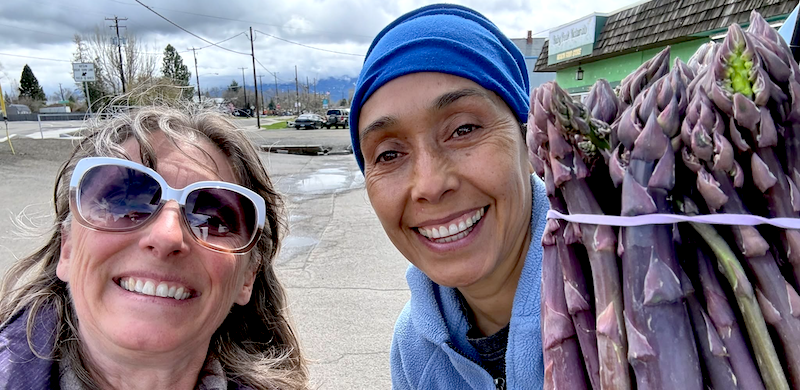
The first wild greens including nettles and fiddleheads are appearing as well, as are the first of the spring onions and garlics. Not-so-wild bundles of another springtime favorite, asparagus, are standing tall on market tables, and piles of pea shoots, sorrel, spinach and fava greens are waiting to star in sautés and salads, along with fresh herbs from chives to chervil and parsley to cilantro.

Sprightly spring greens bring a satisfying crispness to salad bowls.

Another salad sweetheart are the small, white hakurei turnips and the first spring radishes that'll add color and crunch to your salad bowl, and don't forget to include some zing from mizuna and mustard greens to complement the sweetness of spring salad greens. (My recipes for a sweet red wine vinaigrette and a creamy miso vinaigrette will complement then perfectly!)

While you're at the market, don't forget to pick up a big bunch of tulips, dogwood blossoms or lilacs for your table—nothing makes spring feel like it's officially here than a colorful bouquet of local flowers!