
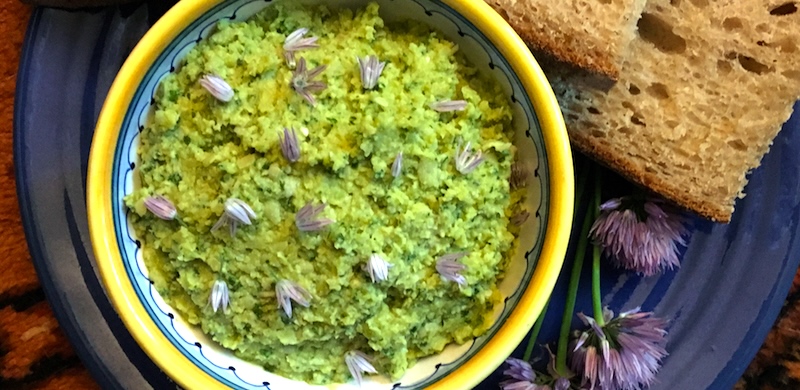
Fava Beans: To Peel, or Not to Peel?

Once again, it's confession time.

I love fava bean season so much that, at the first sign of the bundles of young green shoots on farmers' market tables in the spring, I get a little giddy thinking of them stir-fried with garlic and tossed with pasta and preserved lemon, or slathered with oil and roasted, served alongside a beautiful grilled, pasture-raised chicken thigh. Then there's the knowledge that in just a couple of weeks, it'll be time for the pods to start appearing, their strange, off-green, blobby exteriors revealing pale green kidney-shaped beans pillowed in a porous white cushion.
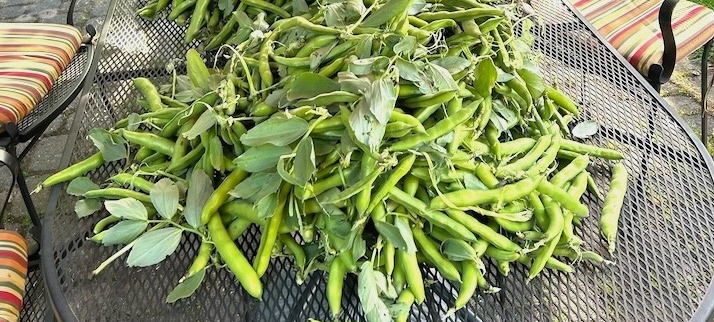
My neighbor Bill loves his favas and grows more than enough to share. Lucky me!

That's about when I remember that to prepare these little beany delights, I have to strip them out of their pods, boil them in a salty pot of water, then spend what seems like hours in the tedious task of popping them out of their skins to get a paltry—albeit decidedly delicious—pile of the bright green, shiny jewels.

I know, I'm whining.

But, wonder of wonders, my friend Nancy Harmon Jenkins, part-time resident of Italy and author of well-regarded books on Italian cuisine like the groundbreaking New Mediterranean Diet and Virgin Territory: Exploring the World of Olive Oil, saved me (and you) from hours of whinging.
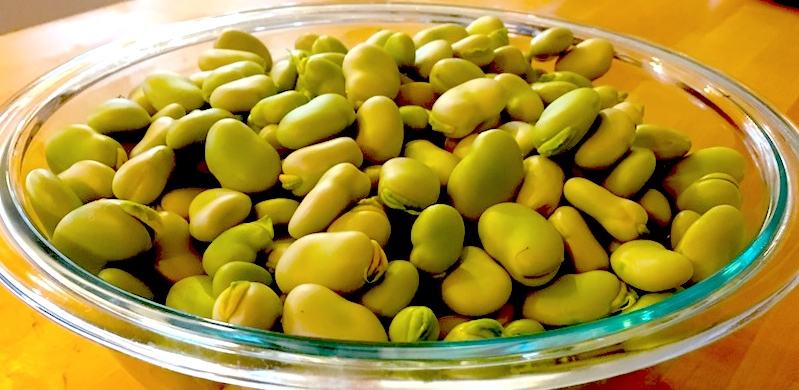
Shucked and ready to boil and use!

In a post on her blog, she excoriates Americans who insist on peeling the skins from their beans:

"What a waste of time! What a waste of flavor!

"Where does this weird practice come from? I suspect from the French professional kitchen where chefs are constantly challenged to come up with new tricks and trucs to keep their enormous brigades de cuisine in operation. In Italy, where restaurant kitchens are run much more economically, no one has to dream up tasks—there are enough to go around and more.

"But why do Americans insist on this? Every food writer except one (me) says you have to peel beans. Then they go through elaborate rigmaroles to show you how to do it. No wonder fava beans are not exactly popular despite their magnificent, slightly earthy flavor, so very different from string beans or limas. Every spring or summer I feel like climbing up in the pulpit and shouting: YOU DON’T HAVE TO DO THAT—IN FACT, IT IS COUNTER-PRODUCTIVE!!!"
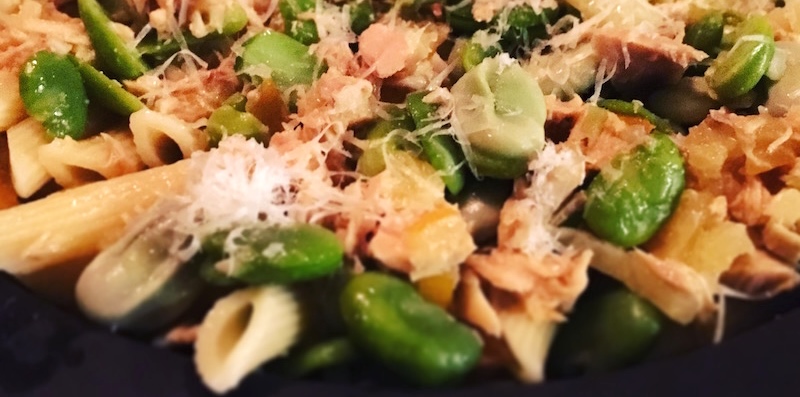
Toss the cooked beans with Oregon albacore and pasta…so simple, so delicious!

Which, as you might imagine, got my attention. And came in mighty handy when my neighbor called offering a grocery bag full of freshly harvested favas from his garden. Let me tell you, I never relished preparing beans more—just shuck, boil in a pot of salted water for ten minutes and they're ready!

While there's a vast universe of serving suggestions, and more cultural trivia about these delicate denizens of early summer, for me, I used some of my neighbor Bill's beans tossed with preserved lemon and albacore, tossed with pasta, sprinkled with chive blossoms and chopped chives, then used the rest to make the following dip for guests. Though when everyone oohed and aahed over the amount of work it took to peel all those beans, I was torn about revealing my secret. (Psst…I did.)

Fava Bean Spread

3 c. shucked beans
2 cloves garlic
1/2 fennel bulb, cut in half, cored and roughly chopped
1/4 c. parsley, coarsely chopped
1/4 c. mint, coarsely chopped
1/3 c. fresh lemon juice
3-4 Tbsp. olive oil
Salt, to taste

Bring a large pot of well-salted water to a boil. Drop in fava beans and cook for ten minutes. Drain and run under very cold water (or ice bath) until cool.

Put beans, garlic, fennel, parsley, mint and lemon juice into the bowl of a food processor. Turn on and while its running drizzle in olive oil until puréed. Adjust lemon juice and olive oil and add salt to taste. Serve with slices of rustic bread or crackers, or on toasted slices of baguette (à la bruschetta).
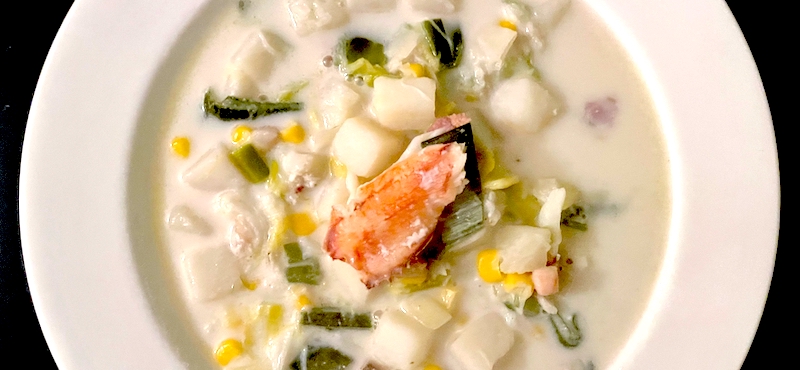

Crustacean Celebration: Kick Off the 2025-26 Dungeness Season with Crab Chowder

Dungeness crab season started on December 16th this year, much to the relief of cooks, diners and Oregon's crab fleet of 424 small family-owned vessels that ply the waters up and down our 362-mile coast. This year's opener, while delayed by a week or so from original predictions, was still weeks earlier than in recent years when it was delayed due to concerns over the presence of domoic acid, a naturally occuring biotoxin that can build up in crustaceans.

Over the past decade, a season opener in December was a rare occurrence, a devastating blow to fishing families who traditionally had relied on holiday sales to home cooks, grocery stores and restaurants to carry them through the winter. The downstream effect on their local communities was no joke, either, causing everyone from hardware stores to grocery stores to gas stations to tighten their belts.

Crab boats dot the horizon at dawn just off the coast at Lincoln City.

This season, though, with its early start and plentiful supply, should be a good one for fishers, coastal communities and crab-lovers alike. To kick off crab season at our house, I'd been jonesing for a festive crab chowder to serve on Christmas Eve. Fortune smiled when I came across my friend Nancy Harmon Jenkins's post about a lobster chowder served at Portland, Maine's iconic Fore Street restaurant. Sam Hayward, its James Beard award-winning chef and co-owner, is considered the dean of Maine's culinary scene. Jenkins wrote:

"[Hayward's] main (Maine) effort has been to inspire us all to Pay Attention—pay attention to quality, pay attention to our relationship to the soil and the waters that surround us, pay attention to what’s happening in our gardens, on our stoves, and on our tables.

"In Sam’s recipe for what he calls Scotian Lobster Chowder (the name, he says, because he learned to make it in Nova Scotia), you can see his thoughtfulness coming to play: the freshly steamed lobster, the specificity of russet potatoes, the density of the thick Jersey cream, the gentle stewing of the leeks in butter, the emphasis on shoe-peg corn."

Like many great classics, the recipe itself* is simple and elegant, with one smashingly simple technique that I'd never run across before: pre-cooking the called-for russet potatoes with leeks to jumpstart the process that lends the chowder its characteristic thickness rather than adding flour, which all to often tends to give it a paste-like, gloppy texture.

Because we are, as noted above, in prime Dungeness season, I chose to substitute our native crustacean for Maine's and make a stock from the shells after picking them of their meat. This is a company-worthy special occasion dish but it's also easy enough to prepare with shrimp or other shellfish instead of the crab on a weeknight.

Here's wishing our fleet a safe and bountiful season!

Dungeness Crab Chowder

3 oz. bacon, cut in 1/4 inch dice
Butter (around half a stick, divided)
2 large russet (baking) potatoes (or 3 medium), peeled and sliced into 1/2" dice
2 medium (or one large) leeks cut in 1/4 inch dice
2 live, large Dungeness crabs
1 c. whole milk
1 c. half-and-half
8 oz. corn cut from the cobs (or 8 oz. frozen)
Salt and freshly ground black pepper to taste

To prepare the live crab, fill a 3 to 5-gallon stock pot 2/3 full of water and bring to a hearty boil. When it's boiling, grab the crabs by the back of the shell (their large front claws are usually banded shut) and slide them, upside-down, into the boiling water. Cover with a lid and boil for 20 minutes. Drain and allow to cool in the sink. (If you're using pre-cooked crabs, start here.)

Instructions on cleaning a crab here. My friend Hank Shaw has a guide for picking the meat here. Remember to save the shells for stock (below).

Once you've picked the meat, set it aside in a bowl in the fridge. Put the shells in a large pot and cover with water (about 1 quart). Bring to a boil on the stove and reduce heat to simmer for 30 minutes. Strain through a fine mesh sieve and reserve the stock.

In a heavy stock pot or Dutch oven, gently sauté the bacon in a teaspoon of butter until it yields its fat and starts to turn crisp on the edges. Add the potatoes and leeks and 1/2" of water, just enough to keep the potatoes from sticking. Bring to a simmer, then cover the pan and cook gently until the vegetables are soft, 20 to 30 minutes.

At the end of the cooking time for the vegetables, add the stock from the crab shells. Combine the milk and half-and-half in a small saucepan and set over medium heat. Bring to a simmer for 2 to 3 minutes to get rid of the rawness, then add to the vegetables and stock, stirring to combine. Add the crab meat and once the chowder comes to a simmer again—don't let it boil or the milk will curdle—turn off the heat, cover the pan, and leave it for 20 minutes. 

Just before serving, bring the chowder to a simmer once more, stir in the corn and simmer 5 to 10 minutes, or until the corn is just done. Adjust the seasoning and serve immediately. If you wish, float a pat of butter (a little more richness) on the surface of each bowl as you serve up the chowder.

Makes 8 servings.


* Get Nancy Harmon Jenkins's recipe for lobster chowder by signing up for a paid subscription or a 7-day free trial.

Photo of crab boats at dawn by my friend Bette Sinclair.