
Growing Gardens: Planting Seeds of Resilience Rooted in Community
This article was written by Portland author Peggy Acott to celebrate the 30th anniversary of Growing Gardens.
Beginning in 1996 with a staff so small you could count them on one hand and still have fingers left over, Growing Gardens is today a robust group of nearly fifty, with program volunteers numbering more than a hundred. They are passionate and persistent in their goal to create a sustainable and equitable food system.
Here in Oregon, as in many regions of the country, hunger and food insecurity are on the rise in this time of perilous economic and political uncertainty, a condition that disproportionately impacts BIPOC and LGBTQIA-plus communities.
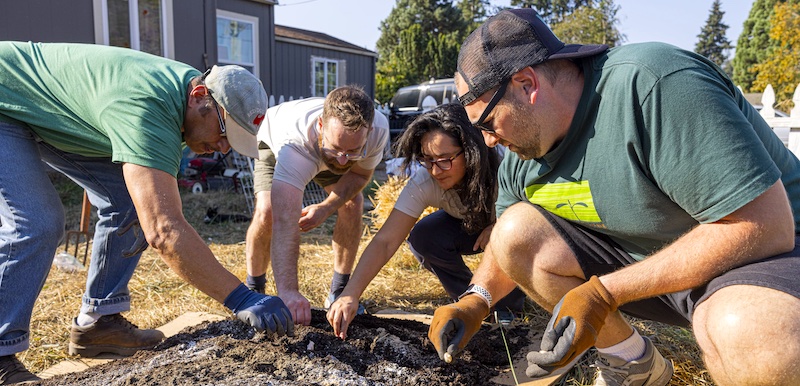
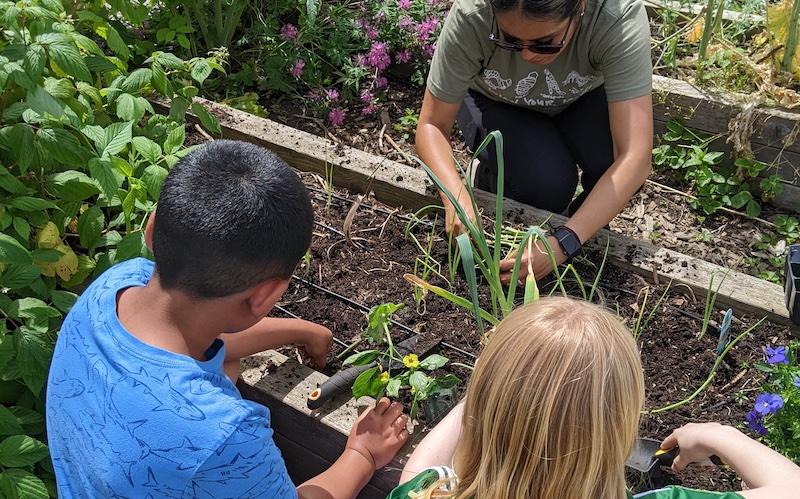
Growing Gardens confronts this imbalance in the food system head on, in very direct ways: The Home Garden Program, which has to date created over 3,000 backyard gardens; a school garden program for students from elementary through high school; and the Lettuce Grow Program, where over 1,500 incarcerated adults and juveniles have access to gardening and garden-based education, with the added benefit of learning job skills that can assist in the successful re-entry back into society.
One of the team members sums it up this way: “What we’re really building is so much more than gardens. We’re growing futures rooted in health, self-sufficiency, and deep community connection.”
When COVID erupted in 2020, the disruption and challenges of lockdowns and interrupted supply chains were immediate and far-reaching. In order to survive, the staff and volunteers employed a combination of online programming and strict distancing practices, and made at-home garden and plant-related projects for students while schools remained closed. It was a demanding and difficult period, but they were committed to keep their mission alive.
“Any nonprofit that survived and made it through was a huge success,” says Executive Director Jason Skipton. “We had to completely transform our programs, but we weren’t going to give up, because ‘No’ was not an answer we could give the community.”
Skipton explained that there had been energy and determination in both the local and national government to allocate funds and resources to help service organizations during the pandemic. But then, just when Skipton and his staff thought the struggle was behind them and were eagerly planning toward the future, the freezing of federal funds in early 2025 dealt them a devastating and demoralizing blow.
“The rug has been ripped out from under us. Now what we’re facing is a political pandemic,” says Skipton, “and we are fighting every day to maintain, be relevant, and keep the doors open.”
It has also created a domino effect among foundations and local government agencies that have become reluctant to provide money when they feel their own resources are in flux. But not all the news has been bad: In the spring of 2025, Hampton Lumber and Parr Lumber collaborated to deliver 20,000 linear board feet of lumber, enough to supply the organization with 100 percent of the lumber needed for the year.
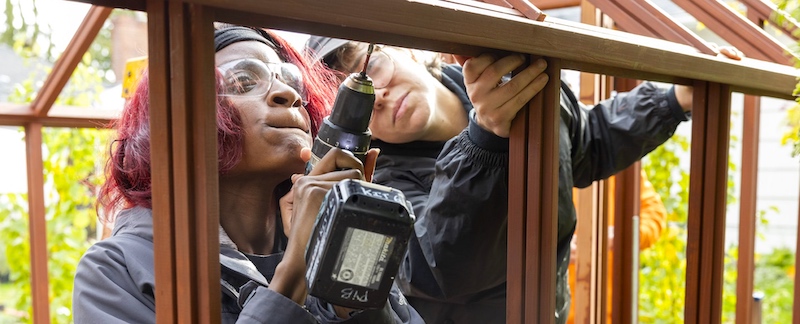
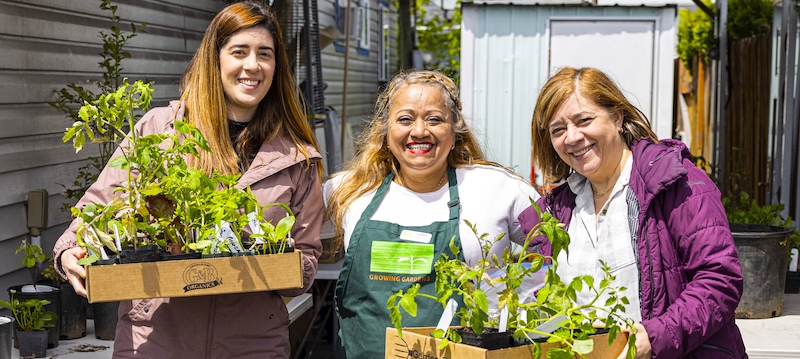
In 2023 an ambitious and far-reaching project—Community Empowerment Through Urban Food System Reliance—received a USDA grant to implement a greenhouse program that would support the development of a locally based food network for low-income and culturally specific communities, increasing their food security and sovereignty. To achieve that, Growing Gardens partnered with Feed’em Freedom Foundation (FFF)—a Black-led food system farming and food access hub—to build a 16’ by 90’ greenhouse at Multnomah County’s CROPS educational farm in Portland’s east county, where the FFF farm leases land. Five smaller greenhouses were also constructed and placed on the properties of selected Growing Gardens community organizers and volunteers. In the large greenhouse, vegetables and flowers will be started from seed. The Foundation will use sixty percent of the greenhouse space to raise plants for their farm and education programs, and Growing Gardens will use forty percent for the plants that will eventually be moved to the five neighborhood greenhouses and distributed to the participants in their programs.
The planning and construction phase has been completed, assisted in large part by the youth of the nonprofit Portland Youth Builders. “They were amazing,” says Program Director Jordana Mendonça Valdés. “We couldn’t have accomplished what we did without them.”
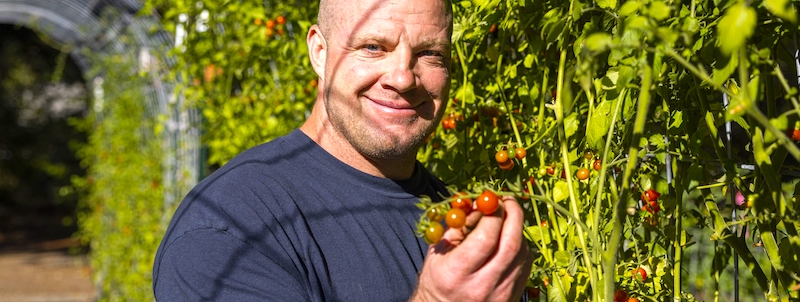
The next phase is teaching the participants about topics like crop planning and greenhouse management practices. It is a challenge to figure out how to best combine the various resources and people involved in order to satisfy everyone’s needs. But Valdés is optimistic. “In the end, it’s the same vision…communities having a say over what they want to eat, nourishing themselves, their families and their neighbors.”
It is the power of this vision, and all the people they work with and get to know, that keeps Skipton and his team going in spite of the setbacks: It’s the delighted look on children’s faces when they discover something delicious that they grew themselves; it’s the news that a man released from his time in prison has the skills to enable him to get a job at a plant nursery; it is the pride of home gardeners who are able to grow and provide fresh food for their families, many of whom then in turn become volunteer mentors to other new gardeners in the Home Garden Program.
Antonio was a first-time participant in the Home Garden program in 2013. Over the next twelve years, his role evolved from volunteer and neighborhood garden advisor to paid staff member, and today he is the Home Garden Community Manager. “Everything I do is to support the community,” he told me. “I wish we could meet all their needs.”
This spring the organization is facing their biggest challenge to date. For reasons that span the upheavals and continuing political and economic climate, funding on every level—federal, state, city, foundations, corporations and individuals—is waning significantly and, in too many cases, cancelled entirely. Often this is occurring with little notice, from funding sources that were thought to be already securely in place. This is a devastating turn of events, one that has the team at Growing Gardens scrambling for solid ground.
“There is a financial shredding at every level of support,” says Skipton. Growing Gardens has weathered an incredible number of challenges in these last few years, where many non-profit organizations have been forced out of existence. Skipton and his staff are working hard to find ways to keep the organization not only alive but thriving into the future.
There is the famous saying: “Give a man a fish and he will eat for a day. Teach him to fish, and he will eat for a lifetime.” But, the ongoing work of Growing Gardens insists we consider the next step in this equation: If he then teaches his neighbors to fish, the entire community will eat for a lifetime.
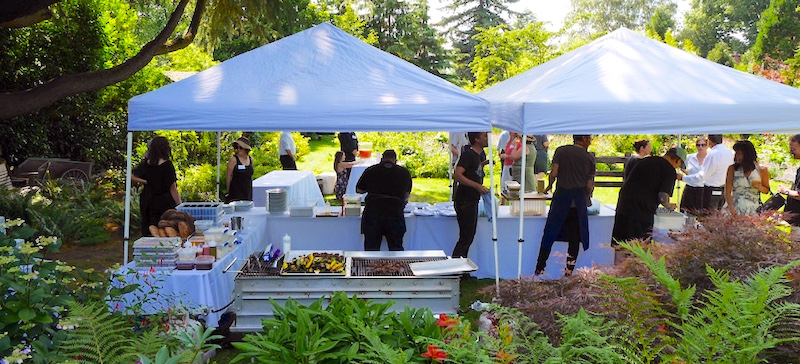 To commemorate their 30th anniversary, Growing Gardens will serve up their celebratory dinner and fundraiser, Chef in Your Garden, on Saturday, Aug. 29th. This year’s event will showcase some of the indigenous food and culture of Oregon. Tickets will be available for purchase on their website, beginning in June. Sign up for their newsletter to be notified.